LEGAL UPDATE: WHAT’S NEW IN THE NEW DRAFT LAW ON LAWYERS 2026?

LEGAL UPDATE: WHAT’S NEW IN THE NEW DRAFT LAW ON LAWYERS 2026?

LEGAL UPDATE:

WHAT’S NEW IN THE NEW DRAFT LAW ON LAWYERS 2026?

A. OVERVIEW

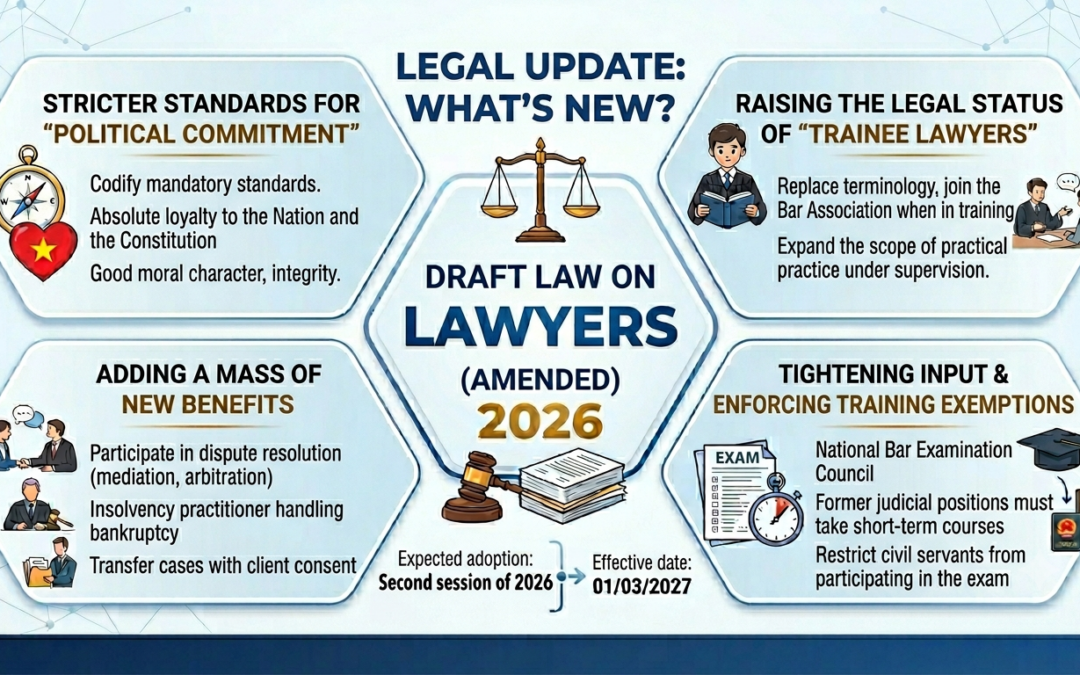
  • Promulgation and Effectiveness: The Draft Law on Lawyers (Amended) is expected to be passed by the 16th National Assembly of the Socialist Republic of Vietnam at its second session in 2026. This Law is anticipated to officially take effect on March 1, 2027, completely replacing the current Law on Lawyers No. 65/2006/QH11.
  • Scope of regulation: The draft comprehensively regulates the principles, standards, conditions, scope, and forms of practicing law. Besides, the law also governs the rights and obligations of lawyers, trainee lawyers, law-practicing organizations, socio-professional organizations of lawyers, the management of lawyers, and the operations of foreign law-practicing organizations and foreign lawyers in Vietnam.
  • Transitional provisions: To protect the legitimate rights and interests of personnel in the process of joining the profession, the draft stipulates that those currently undergoing traineeship under the old law will continue to have their traineeship period calculated under the new law. The results of the law practice traineeship examination under current regulations remain valid to request the issuance of a Lawyer Practicing Certificate until the end of January 1, 2030. Notably, cadres, civil servants, public employees, and military officers, after being granted the Practicing Certificate, have the right to join the Bar Association to become “public lawyers” (luật sư công) in accordance with the pilot Resolution of the National Assembly.

B. SEVERAL NEED-TO-KNOW ISSUES

  1. Supplementing stricter standards on “Political fortitude”
  • Main content: The breakthrough highlight of the draft is the codification of the standard “having firm political fortitude” into a prerequisite and mandatory condition to join the contingent of lawyers. This is an orientation to build a team of lawyers with pure ethics and a firm political stance.
  • Legal basis: Article 7 of the Draft Law.
  • Conditions, procedures, obligations: Besides professional foundations such as holding a bachelor’s degree in law or higher and completing vocational training, Vietnamese citizens wishing to become lawyers must demonstrate absolute loyalty to the Fatherland and the Constitution. Concurrently, practitioners must prove their good moral character, courageous spirit, and determination to protect justice, integrity, and honesty.
  1. Elevating legal status with the designation “Trainee lawyer”
  • Main content: The draft replaces the term “apprentice in law practice” with “trainee lawyer”, thereby approaching international practices and elevating the status of this group of subjects. Along with the new title, trainee lawyers are officially allowed to join the Bar Association right during the traineeship stage and have an expanded scope of practice.
  • Legal basis: Article 2, Article 9 of the Draft Law.
  • Conditions, procedures, obligations: The standard traineeship period is 12 months. Trainee lawyers are entitled to participate in legal proceedings in civil cases and administrative cases at the regional People’s Court, and simultaneously provide legal advice and draft documents. However, all these activities must be subject to the assignment and supervision of the guiding lawyer, with the client’s consent, and they must absolutely not sign legal advisory documents themselves.
  1. Supplementing a series of new rights for Lawyers
  • Main content: The draft grants more powerful “legal weapons”, allowing lawyers to participate more deeply and broadly in the economy and legal life. Lawyers are empowered to represent clients in dispute resolution as mediators, arbitrators, or directly participate in corporate recovery and bankruptcy handling under the title of bankruptcy administrators.
  • Legal basis: Article 12 of the Draft Law.
  • Conditions, procedures, obligations: The draft also adds a flexible mechanism allowing lawyers the right to transfer cases to other lawyers. To execute this right, the lawyer must ensure the prerequisite condition of having the client’s consent or proving the occurrence of a force majeure event.
  1. Tightening the National Examination and restricting the training exemption
  • Main content: The input quality management structure is tightened through the establishment of the National Examination Council for Lawyers. The draft also restricts the scope of training exemption, requiring those who formerly held judicial titles (judges, prosecutors, investigators) to undergo a short-term lawyer vocational training course in order to change their procedural mindset and strictly comply with the legal professional code of ethics.
  • Legal basis: Article 8, Article 10 of the Draft Law.
  • Conditions, procedures, obligations: Every trainee lawyer, after completing the 12-month traineeship, must mandatorily pass the national examination for lawyers to be considered for the Practicing Certificate. Incumbent cadres, civil servants, public employees, and armed forces personnel (except for law lecturers) shall not be permitted to attend this exam.

IN SUMMARY: The Draft Law on Lawyers (Amended) 2026 clearly reflects a new and integrative legislative mindset: on one hand, it grants more tools and an open legal space for lawyers to maximize their role; on the other hand, it establishes strict technical barriers regarding political, training, and examination standards to filter, elevate the position, and improve the quality of the legal services market in Vietnam.
 

CẬP NHẬT PHÁP LÝ: MỘT SỐ ĐIỂM MỚI TRONG DỰ THẢO LUẬT LUẬT SƯ (SỬA ĐỔI) 2026

CẬP NHẬT PHÁP LÝ: MỘT SỐ ĐIỂM MỚI TRONG DỰ THẢO LUẬT LUẬT SƯ (SỬA ĐỔI) 2026

CẬP NHẬT PHÁP LÝ:

MỘT SỐ ĐIỂM MỚI TRONG DỰ THẢO LUẬT LUẬT SƯ (SỬA ĐỔI) 2026

A. TỔNG QUAN

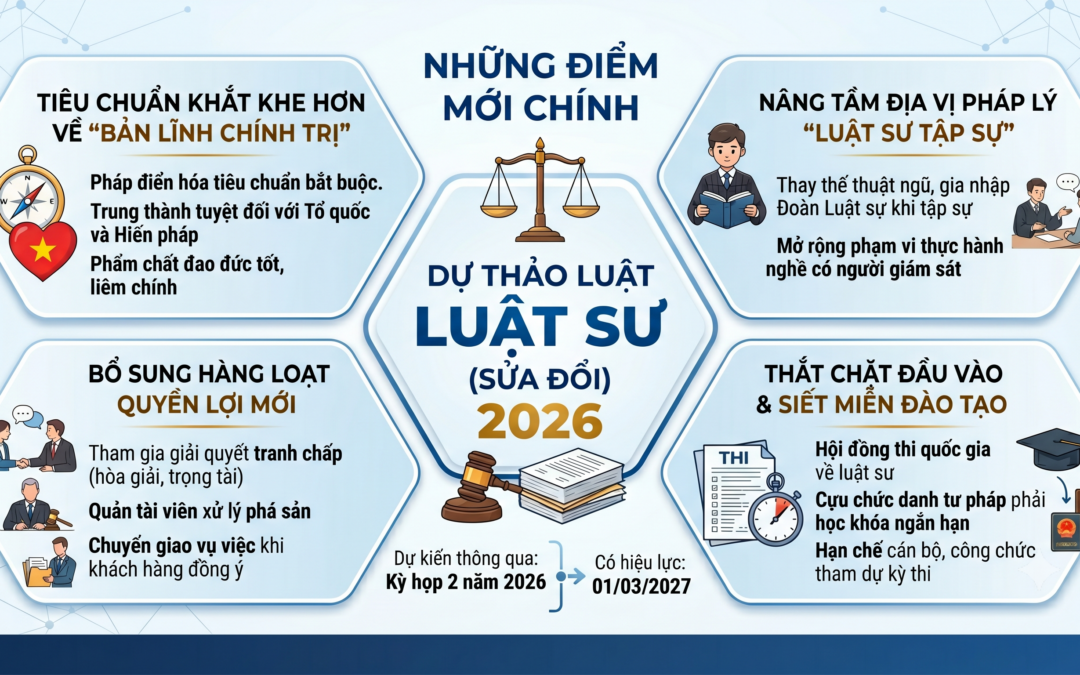
  • Ban hành và Hiệu lực: Dự thảo Luật Luật sư (sửa đổi) dự kiến sẽ được Quốc hội nước Cộng hòa xã hội chủ nghĩa Việt Nam khóa XVI tiến hành biểu quyết thông qua tại Kỳ họp thứ hai năm 2026. Đạo luật này dự kiến sẽ chính thức có hiệu lực thi hành kể từ ngày 01/03/2027, thay thế hoàn toàn cho Luật Luật sư số 65/2006/QH11 hiện hành.
  • Phạm vi điều chỉnh: Dự thảo quy định toàn diện về các nguyên tắc, tiêu chuẩn, điều kiện, phạm vi và hình thức hành nghề của luật sư. Bên cạnh đó, luật cũng điều chỉnh quyền, nghĩa vụ của luật sư, luật sư tập sự, tổ chức hành nghề luật sư, tổ chức xã hội – nghề nghiệp của luật sư, công tác quản lý luật sư và hoạt động của tổ chức hành nghề luật sư nước ngoài, luật sư nước ngoài tại Việt Nam.
  • Điều khoản chuyển tiếp: Nhằm bảo vệ quyền lợi hợp pháp cho những nhân sự đang trong quá trình gia nhập ngành, dự thảo quy định người đang tập sự theo luật cũ sẽ tiếp tục được tính thời gian tập sự theo luật mới. Kết quả kiểm tra tập sự hành nghề luật sư theo quy định hiện hành vẫn có giá trị để đề nghị cấp Chứng chỉ hành nghề luật sư cho đến hết ngày 01/01/2030. Đặc biệt, cán bộ, công chức, viên chức, sĩ quan sau khi được cấp Chứng chỉ hành nghề có quyền gia nhập Đoàn Luật sư để trở thành “luật sư công” tuân theo Nghị quyết thí điểm của Quốc hội.

B. MỘT SỐ VẤN ĐỀ CẦN BIẾT

  1. Bổ sung tiêu chuẩn khắt khe hơn về “Bản lĩnh chính trị”
  • Nội dung chính: Điểm nhấn mang tính đột phá của dự thảo là việc pháp điển hóa tiêu chuẩn “có bản lĩnh chính trị vững vàng” trở thành một điều kiện tiên quyết và bắt buộc để gia nhập đội ngũ luật sư. Đây là định hướng nhằm xây dựng một đội ngũ luật sư trong sáng về đạo đức, vững vàng về lập trường chính trị.
  • Căn cứ pháp lý: Điều 7 Dự thảo Luật.
  • Điều kiện, thủ tục, nghĩa vụ: Bên cạnh nền tảng chuyên môn như có bằng cử nhân luật trở lên và hoàn thành đào tạo nghề, công dân Việt Nam muốn trở thành luật sư phải thể hiện sự trung thành tuyệt đối với Tổ quốc và Hiến pháp. Đồng thời, người hành nghề phải minh chứng được phẩm chất đạo đức tốt, tinh thần dũng cảm, kiên quyết bảo vệ công lý, liêm chính và trung thực.
  1. Nâng tầm địa vị pháp lý với định danh “Luật sư tập sự”
  • Nội dung chính: Dự thảo đã thay thế thuật ngữ “người tập sự hành nghề luật sư” thành “luật sư tập sự”, qua đó tiệm cận với thông lệ quốc tế và nâng tầm vị thế của nhóm chủ thể này. Cùng với danh xưng mới, luật sư tập sự được chính thức gia nhập Đoàn Luật sư ngay trong giai đoạn tập sự và được mở rộng phạm vi thực hành nghề.
  • Căn cứ pháp lý: Điều 2, Điều 9 Dự thảo Luật.
  • Điều kiện, thủ tục, nghĩa vụ: Thời gian tập sự tiêu chuẩn là 12 tháng. Luật sư tập sự được quyền tham gia tố tụng trong các vụ việc dân sự, vụ án hành chính tại Tòa án nhân dân khu vực, đồng thời được thực hiện tư vấn pháp lý và soạn thảo tài liệu. Tuy nhiên, mọi hoạt động này bắt buộc phải chịu sự phân công, giám sát của luật sư hướng dẫn, có sự đồng ý của khách hàng và tuyệt đối không được tự mình ký văn bản tư vấn pháp luật.
  1. Bổ sung hàng loạt quyền lợi mới cho Luật sư
  • Nội dung chính: Dự thảo trao thêm những “vũ khí pháp lý” mạnh mẽ, cho phép luật sư tham gia sâu rộng hơn vào nền kinh tế và đời sống pháp luật. Luật sư được trao quyền đại diện cho khách hàng tham gia giải quyết tranh chấp với tư cách là hòa giải viên, trọng tài viên, hoặc trực tiếp tham gia xử lý phục hồi, phá sản doanh nghiệp dưới danh nghĩa quản tài viên.
  • Căn cứ pháp lý: Điều 12 Dự thảo Luật.
  • Điều kiện, thủ tục, nghĩa vụ: Dự thảo cũng bổ sung cơ chế linh hoạt cho phép luật sư được quyền chuyển giao vụ việc cho luật sư khác. Để thực hiện quyền này, luật sư phải đảm bảo điều kiện kiên quyết là có sự đồng ý của khách hàng hoặc chứng minh được sự kiện bất khả kháng xảy ra.
  1. Thắt chặt kỳ thi Quốc gia và siết lại diện miễn đào tạo
  • Nội dung chính: Cấu trúc quản lý chất lượng đầu vào được thắt chặt thông qua việc thành lập Hội đồng thi quốc gia về luật sư. Dự thảo cũng hạn chế diện miễn đào tạo, yêu cầu những người từng giữ các chức danh tư pháp cũ (thẩm phán, kiểm sát viên, điều tra viên) phải trải qua khóa đào tạo nghề luật sư ngắn hạn nhằm thay đổi tư duy tố tụng và tuân thủ chặt chẽ quy tắc đạo đức nghề luật.
  • Căn cứ pháp lý: Điều 8, Điều 10 Dự thảo Luật.
  • Điều kiện, thủ tục, nghĩa vụ: Mọi luật sư tập sự, sau khi hoàn thành 12 tháng tập sự, đều bắt buộc phải vượt qua kỳ thi quốc gia về luật sư để được xem xét cấp Chứng chỉ hành nghề. Những cá nhân đang là cán bộ, công chức, viên chức, lực lượng vũ trang đương nhiệm (trừ giảng viên chuyên ngành luật) sẽ không được phép tham dự kỳ thi này.

TÓM LẠI: Dự thảo Luật Luật sư (sửa đổi) 2026 thể hiện rõ nét tư duy lập pháp mới và hội nhập: một mặt trao thêm các công cụ và không gian pháp lý rộng mở để luật sư phát huy tối đa vai trò; mặt khác, thiết lập hàng rào kỹ thuật nghiêm ngặt về quy chuẩn chính trị, đào tạo và thi cử nhằm tinh lọc, nâng tầm vị thế và chất lượng của thị trường dịch vụ pháp lý tại Việt Nam.


NEED TO KNOW LEGAL ISSUES IN ELECTRONIC CONTRACTS

NEED TO KNOW LEGAL ISSUES IN ELECTRONIC CONTRACTS

NEED-TO-KNOW

LEGAL ISSUES IN ELECTRONIC CONTRACTS

A. OVERVIEW

  • Promulgation and Effective Date: The Law on Electronic Transactions No. 20/2023/QH15 was passed by the National Assembly on June 22, 2023, and officially takes effect from July 1, 2024. The promulgation of this law aims to replace the Law on Electronic Transactions 2005, thereby creating a complete and synchronous legal framework, strongly serving the national digital transformation.
  • Scope of Regulation: A breakthrough of the new Law is the comprehensive expansion of its scope of application. The Law currently regulates the implementation of transactions by electronic means in all activities of agencies, organizations, and individuals. Unlike before, the law no longer excludes important fields such as land, inheritance, and valuable papers, except in cases where specialized laws prohibit implementation by electronic means.
  • Transitional Provisions: To ensure stability, digital certificates and licenses issued before June 22, 2023, shall continue to be valid until their expiration date. In particular, the confirmation of registration for the provision of electronic contract authentication services in commerce shall continue to be used until the end of June 30, 2027.

B. SEVERAL NEED-TO-KNOW ISSUES

  1. Concept and Legal Validity of Electronic Contracts
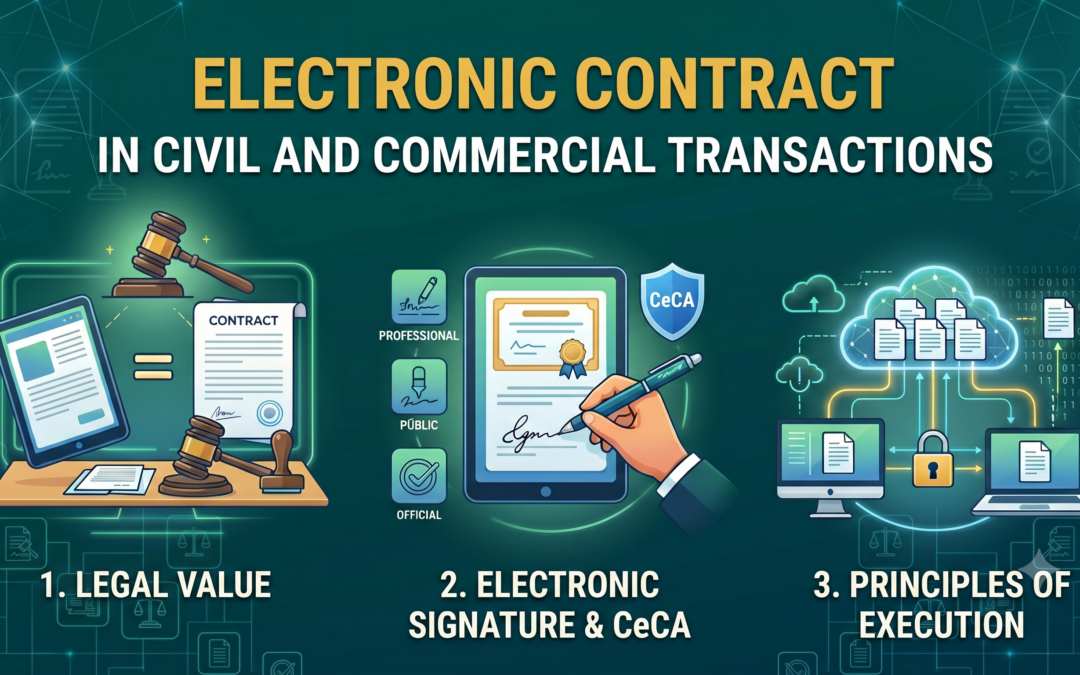
  • Main content: An electronic contract is defined as a contract established in the form of a data message. As a core principle, an electronic contract has legal validity entirely equivalent to a traditional paper contract; its legal validity cannot be denied solely because it is expressed in electronic form or generated and entered into through automated information systems.
  • Legal basis: Article 34 of the Law on Electronic Transactions 2023; Article 401 of the Civil Code 2015.
  • Conditions, procedures, and obligations: Similar to traditional contracts, electronic contracts must satisfy the general conditions for the validity of civil transactions, such as: the subjects’ civil behavioral capacity, voluntariness, and purposes that do not violate legal prohibitions. Technically, the information in the contract must ensure integrity (unaltered, except for formal changes during storage and display) and be accessible and usable in its complete form for reference when necessary.
  1. Principles of Entering into and Executing Contracts
  • Main content: Entering into an electronic contract means using data messages to conduct part or all of the transaction. Participating parties are granted the freedom to agree on the use of electronic means, freely negotiate technical requirements, as well as conditions ensuring the integrity and confidentiality of the contract.
  • Legal basis: Articles 35 and 36 of the Law on Electronic Transactions 2023.
  • Conditions, procedures, and obligations: The process of entering into a contract must strictly comply with the Law on Electronic Transactions, contract laws, and relevant specialized laws. Notably, during the execution and performance processes, notifications in the form of data messages have the exact same legal validity as paper-based notifications.
  1. Role and Classification of Electronic Signatures
  • Main content: An electronic signature is a core legal tool to verify the identity of the signatory and confirm their approval of the contract’s content. The Law on Electronic Transactions 2023 clearly classifies electronic signatures into 3 groups: specialized electronic signatures, public digital signatures, and specialized digital signatures for official duties.
  • Legal basis: Articles 22, 23, and 25 of the Law on Electronic Transactions 2023.
  • Conditions, procedures, and obligations: A digital signature is recognized as a lawful electronic signature when the signature creation data is exclusively linked to the approved content of the data message, is under the sole control of the signatory at the time of signing, and any subsequent alteration to the data message can be detected. A secure specialized electronic signature or a digital signature shall have a legal validity equivalent to a handwritten signature.
  1. Trust Services and Electronic Contract Authentication (CeCA)
  • Main content: To enhance security and prevent disputes, the Law adds a mechanism on “Trust Services”, including: issuing time stamps, data message authentication, and public digital signature authentication. When utilizing electronic contract authentication services from CeCA (Certified e-Contract Authority) organizations, the contract will be “blue-ticked,” ensuring the highest level of integrity and non-repudiation.
  • Legal basis: Articles 28 and 29 of the Law on Electronic Transactions 2023.
  • Conditions, procedures, and obligations: Providing trust services is a conditional business line. Providing organizations must be licensed by the Ministry of Information and Communications, meeting strict standards on finance, personnel, and technical systems ensuring information security. For electronic contract authentication organizations in commerce, in addition to the above conditions, they must also meet the provisions of e-commerce laws.

IN SUMMARY:With the introduction of the Law on Electronic Transactions 2023, electronic contracts now have a solid legal framework, recognizing their value as equivalent to traditional contracts. For transactions to take place quickly, safely, and with high evidentiary value, subjects need to focus on meeting the formal conditions of data messages, utilizing compliant digital signatures, and considering the use of reliable electronic authentication services to optimally protect their legitimate rights and interests.


MỘT SỐ VẤN ĐỀ PHÁP LÝ CẦN BIẾT  VỀ HỢP ĐỒNG ĐIỆN TỬ

MỘT SỐ VẤN ĐỀ PHÁP LÝ CẦN BIẾT VỀ HỢP ĐỒNG ĐIỆN TỬ

MỘT SỐ VẤN ĐỀ PHÁP LÝ CẦN BIẾT

VỀ HỢP ĐỒNG ĐIỆN TỬ

A. TỔNG QUAN

  • Ban hành và Hiệu lực: Luật Giao dịch điện tử số 20/2023/QH15 được Quốc hội thông qua vào ngày 22/06/2023 và chính thức có hiệu lực thi hành từ ngày 01/07/2024. Việc ban hành đạo luật này nhằm thay thế cho Luật Giao dịch điện tử năm 2005, qua đó tạo ra một hành lang pháp lý hoàn thiện, đồng bộ, phục vụ mạnh mẽ cho công cuộc chuyển đổi số quốc gia.
  • Phạm vi điều chỉnh: Một bước tiến mang tính đột phá của Luật mới là sự mở rộng toàn diện về phạm vi áp dụng. Luật hiện điều chỉnh việc thực hiện giao dịch bằng phương tiện điện tử trong mọi hoạt động của cơ quan, tổ chức và cá nhân. Khác với trước đây, pháp luật không còn loại trừ các lĩnh vực quan trọng như đất đai, thừa kế, giấy tờ có giá, trừ trường hợp luật chuyên ngành có quy định cấm thực hiện bằng phương tiện điện tử.
  • Điều khoản chuyển tiếp: Nhằm bảo đảm sự ổn định, các chứng thư số, giấy phép, giấy chứng nhận đã được cấp trước ngày 22/06/2023 vẫn tiếp tục có giá trị sử dụng cho đến hết thời hạn. Đặc biệt, xác nhận đăng ký hoạt động cung cấp dịch vụ chứng thực hợp đồng điện tử trong thương mại được tiếp tục sử dụng đến hết ngày

B. MỘT SỐ VẤN ĐỀ CẦN BIẾT

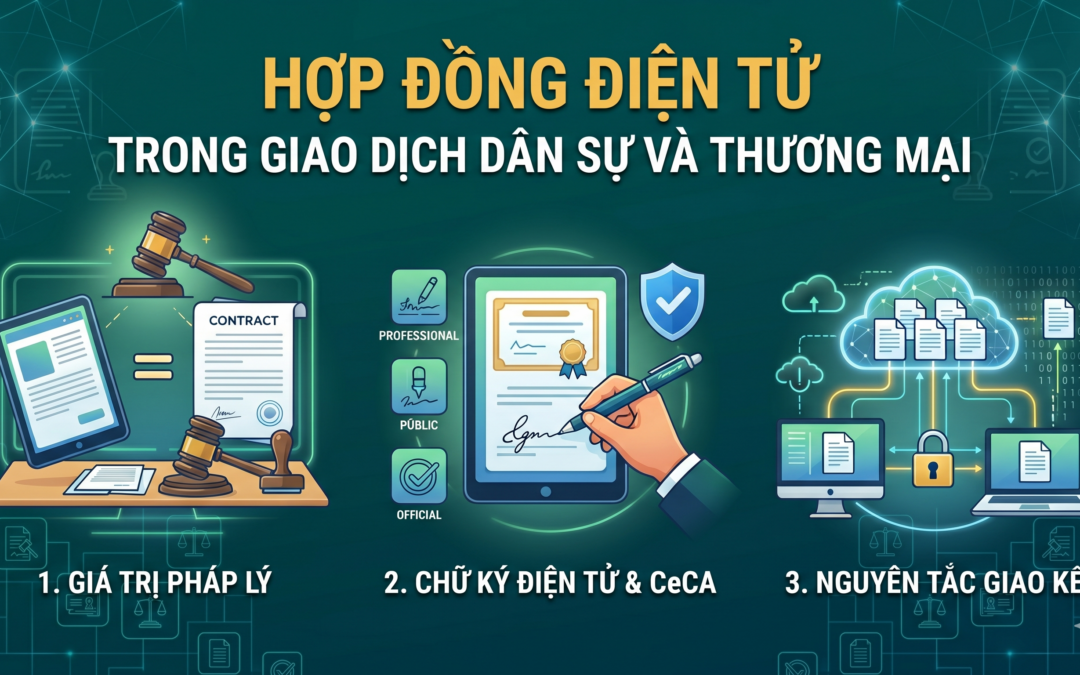
  1. Khái niệm và Giá trị pháp lý của hợp đồng điện tử
  • Nội dung chính: Hợp đồng điện tử được định nghĩa là hợp đồng được thiết lập dưới dạng thông điệp dữ liệu. Về nguyên tắc cốt lõi, hợp đồng điện tử có giá trị pháp lý hoàn toàn tương đương với hợp đồng giấy truyền thống; không thể bị phủ nhận giá trị pháp lý chỉ vì hợp đồng đó được thể hiện dưới dạng điện tử hay được khởi tạo, giao kết thông qua các hệ thống thông tin tự động.
  • Căn cứ pháp lý: Điều 34 Luật Giao dịch điện tử 2023; Điều 401 Bộ luật Dân sự 2015.
  • Điều kiện, thủ tục, nghĩa vụ: Tương tự hợp đồng truyền thống, hợp đồng điện tử phải thỏa mãn các điều kiện có hiệu lực chung của giao dịch dân sự như: năng lực hành vi của chủ thể, sự tự nguyện, và mục đích không vi phạm điều cấm của luật. Về mặt kỹ thuật, thông tin trong hợp đồng phải bảo đảm tính toàn vẹn (chưa bị thay đổi, trừ các thay đổi về hình thức trong quá trình lưu trữ, hiển thị) và có thể truy cập, sử dụng được dưới dạng hoàn chỉnh để tham chiếu khi cần thiết.
  1. Nguyên tắc giao kết và thực hiện hợp đồng
  • Nội dung chính: Giao kết hợp đồng điện tử là việc sử dụng thông điệp dữ liệu để tiến hành một phần hoặc toàn bộ giao dịch. Các bên tham gia được trao quyền tự do thỏa thuận về việc sử dụng phương tiện điện tử, tự do đàm phán các yêu cầu kỹ thuật, cũng như các điều kiện bảo đảm tính toàn vẹn và bảo mật của hợp đồng.
  • Căn cứ pháp lý: Điều 35, Điều 36 Luật Giao dịch điện tử 2023.
  • Điều kiện, thủ tục, nghĩa vụ: Quá trình giao kết phải tuân thủ nghiêm ngặt Luật Giao dịch điện tử, pháp luật về hợp đồng và các pháp luật chuyên ngành liên quan. Đặc biệt, trong quá trình giao kết và thực hiện, các thông báo dưới dạng thông điệp dữ liệu hoàn toàn có giá trị pháp lý như thông báo bằng văn bản giấy.
  1. Vai trò và phân loại Chữ ký điện tử
  • Nội dung chính: Chữ ký điện tử là công cụ pháp lý cốt lõi để xác nhận danh tính của chủ thể ký và khẳng định sự chấp thuận của họ đối với nội dung hợp đồng. Luật GDĐT 2023 phân loại chữ ký điện tử thành 3 nhóm rõ ràng: Chữ ký điện tử chuyên dùng, Chữ ký số công cộng và Chữ ký số chuyên dùng công vụ.
  • Căn cứ pháp lý: Điều 22, Điều 23, Điều 25 Luật Giao dịch điện tử 2023.
  • Điều kiện, thủ tục, nghĩa vụ: Một chữ ký số được công nhận là chữ ký điện tử hợp pháp khi dữ liệu tạo chữ ký chỉ gắn duy nhất với nội dung thông điệp dữ liệu được chấp thuận, nằm dưới sự kiểm soát độc quyền của người ký tại thời điểm ký, và bất kỳ sự thay đổi nào đối với thông điệp dữ liệu sau khi ký đều có thể bị phát hiện. Chữ ký điện tử chuyên dùng bảo đảm an toàn hoặc chữ ký số sẽ có giá trị pháp lý tương đương với chữ ký tay.
  1. Dịch vụ tin cậy và Chứng thực hợp đồng điện tử (CeCA)
  • Nội dung chính: Để tăng cường độ an toàn và phòng ngừa tranh chấp, Luật bổ sung chế định về “Dịch vụ tin cậy”, bao gồm: cấp dấu thời gian, chứng thực thông điệp dữ liệu và chứng thực chữ ký số công cộng. Khi sử dụng dịch vụ chứng thực hợp đồng điện tử từ các tổ chức CeCA (Certified e-Contract Authority), hợp đồng sẽ mang “tích xanh”, bảo đảm tính toàn vẹn và chống chối bỏ ở mức độ cao nhất.
  • Căn cứ pháp lý: Điều 28, Điều 29 Luật Giao dịch điện tử 2023.
  • Điều kiện, thủ tục, nghĩa vụ: Cung cấp dịch vụ tin cậy là ngành nghề kinh doanh có điều kiện. Tổ chức cung cấp phải được Bộ Thông tin và Truyền thông cấp phép, đáp ứng nghiêm ngặt các tiêu chuẩn về tài chính, nhân lực và hệ thống kỹ thuật bảo đảm an toàn thông tin. Đối với tổ chức chứng thực hợp đồng điện tử trong thương mại, ngoài các điều kiện trên, còn phải đáp ứng các quy định của pháp luật về thương mại điện tử.

TÓM LẠI: Với sự ra đời của Luật Giao dịch điện tử 2023, hợp đồng điện tử đã có một hành lang pháp lý vững chắc, thừa nhận giá trị tương đương với hợp đồng truyền thống. Để giao dịch được diễn ra nhanh chóng, an toàn và có giá trị chứng minh cao, các chủ thể cần chú trọng đáp ứng các điều kiện về hình thức của thông điệp dữ liệu, sử dụng chữ ký số hợp chuẩn và cân nhắc tận dụng các dịch vụ chứng thực tin cậy nhằm tối ưu hóa việc bảo vệ quyền lợi hợp pháp của mình.

NEED TO KNOW LEGAL ISSUES IN THE CONSULAR LEGALIZATION OF FOREIGN DOCUMENTS USED IN VIETNAM

NEED TO KNOW LEGAL ISSUES IN THE CONSULAR LEGALIZATION OF FOREIGN DOCUMENTS USED IN VIETNAM

NEED-TO-KNOW

LEGAL ISSUES IN THE CONSULAR LEGALIZATION OF FOREIGN DOCUMENTS USED IN VIETNAM

A. OVERVIEW

  • Promulgation and Effectiveness: The fundamental legal framework for consular legalization is stipulated in Decree No. 111/2011/ND-CP dated December 5, 2011; Decree No. 196/2025/ND-CP dated July 4, 2025, amending and supplementing Decree No. 111/2011/ND-CP, which takes effect on August 3, 2025.
  • Scope of Regulation: Regulates the competence, order, and procedures for the consular legalization of foreign papers and documents to be recognized and used in Vietnam.
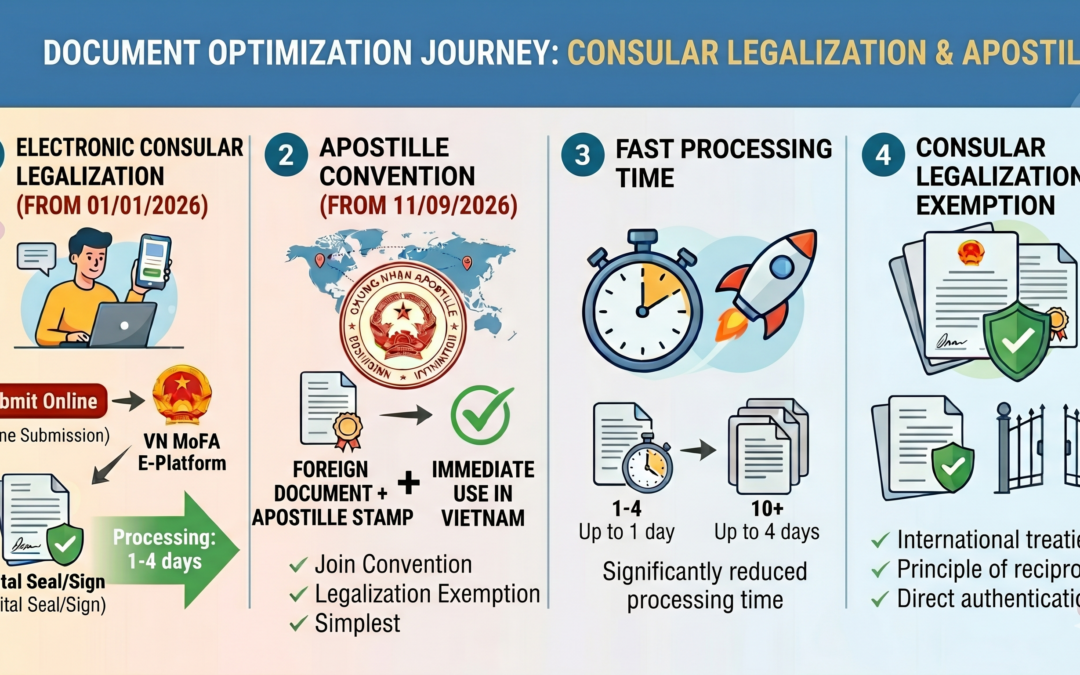
  • Transitional Provisions: For dossiers submitted before August 3, 2025, the provisions of Decree 111/2011/ND-CP shall continue to apply. Notably, the regulations on electronic consular certification and legalization will be officially applied from January 1, 2026.

B. SEVERAL NEED-TO-KNOW ISUES  

  1. The nature and mandatory requirements of consular legalization
  • Main content: Consular legalization is the certification by competent Vietnamese agencies of the stamps, signatures, and titles on foreign papers and documents so that they can be recognized and legally used in Vietnam. It should be noted that this procedure only certifies the form (stamp, signature, title) and does not entail the certification of the content of the documents.
  • Legal basis: Articles 2, 3, and 4 of Decree 111/2011/ND-CP.
  • Conditions, procedures, and obligations: Except for exempted cases, all foreign papers and documents intended to be recognized and used legally in Vietnam must mandatorily undergo the consular legalization procedure.

2. Cases where foreign documents are exempted from consular legalization

  • Main content: According to the latest regulations, foreign documents are exempted from consular legalization if they fall into one of the following cases: (i) Under an international treaty to which both Vietnam and the relevant foreign country are members, or based on the principle of reciprocity; (ii) Transferred directly or via diplomatic channels between competent authorities; (iii) Under the provisions of Vietnamese law; (iv) The receiving agency in Vietnam does not require it, based on its ability to self-determine the authenticity of the documents. Notably, Vietnam has officially acceded to the 1961 Hague Convention (Apostille Convention) abolishing the requirement of legalization for foreign public documents, which will take effect on September 11, 2026. From this point onward, public documents only need a single certification (Apostille stamp) issued by the originating country to be valid in member countries.
  • Legal basis: Article 9 of Decree 111/2011/ND-CP (amended by Decree 196/2025/ND-CP).

3. Cases of refusal of consular legalization

  • Main content: Competent authorities will refuse legalization if the documents fall into these categories: erased or modified without proper legal correction; forged or issued ultra vires (beyond authority); or containing contents that infringe upon the interests of the State of Vietnam. For paper documents, the signatures and stamps must be original. For electronic documents (applicable from 2026), the documents will be refused if they lack the digital signature of the competent person/agency, or fail to ensure data integrity and authenticity according to regulations on electronic transactions.
  • Legal basis: Article 10 of Decree 111/2011/ND-CP (amended and supplemented by Decree 196/2025/ND-CP).

4. Procedures and methods of submitting consular legalization dossiers

  • Main content: Investors can submit dossiers directly, via postal service, or online through the National Public Service Portal using an electronic identity account. A basic dossier includes: An application declaration form, personal identification documents, the documents requesting legalization (already certified by the foreign diplomatic mission), and a Vietnamese or English translation.The processing time has been shortened: 01 working day (for 1 to 4 documents), no more than 02 working days (for 5 to 9 documents), and a maximum of 04 working days for 10 or more documents.
  • Legal basis: Articles 14, 15, and 15a of Decree 111/2011/ND-CP (amended and supplemented by Decree 196/2025/ND-CP).

IN SUMMARY:Consular legalization is an essential legal step for foreign documents to take effect in Vietnam. The promulgation of Decree 196/2025/ND-CP, along with Vietnam’s accession to the Apostille Convention (effective in 2026), marks a major turning point in administrative procedure reform, process digitization, and cost reduction. Investors need to firmly grasp the list of exempted documents, ensure the legality of the original documents, and utilize the online submission method to optimize the time required to carry out investment procedures.