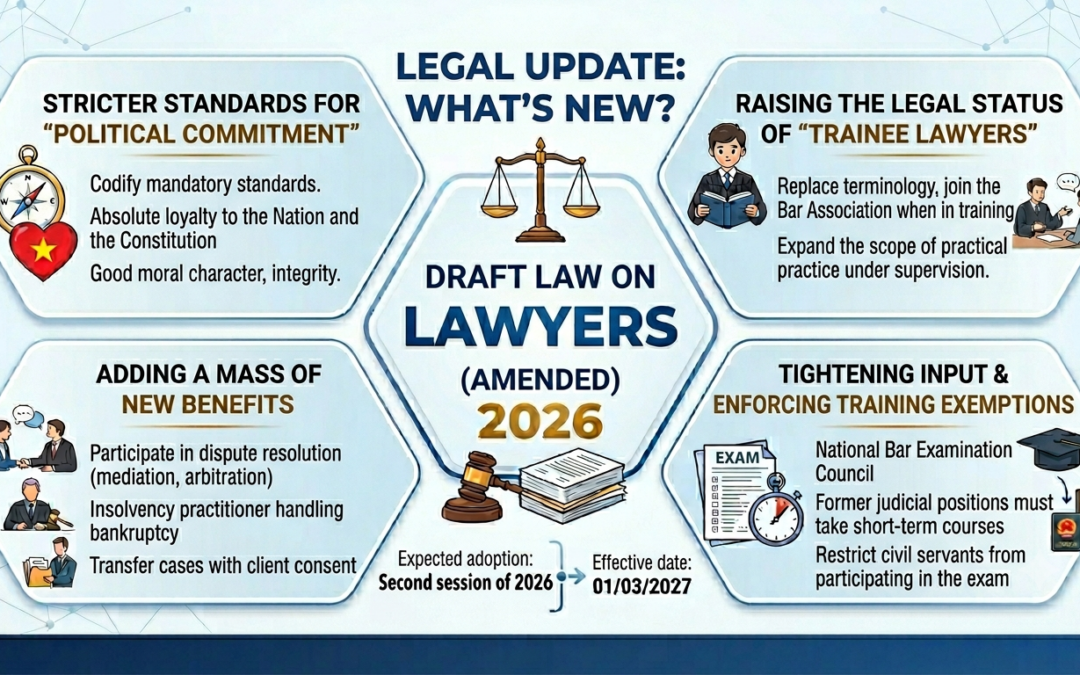
LEGAL UPDATE:
WHAT’S NEW IN THE NEW DRAFT LAW ON LAWYERS 2026?
A. OVERVIEW
- Promulgation and Effectiveness: The Draft Law on Lawyers (Amended) is expected to be passed by the 16th National Assembly of the Socialist Republic of Vietnam at its second session in 2026. This Law is anticipated to officially take effect on March 1, 2027, completely replacing the current Law on Lawyers No. 65/2006/QH11.
- Scope of regulation: The draft comprehensively regulates the principles, standards, conditions, scope, and forms of practicing law. Besides, the law also governs the rights and obligations of lawyers, trainee lawyers, law-practicing organizations, socio-professional organizations of lawyers, the management of lawyers, and the operations of foreign law-practicing organizations and foreign lawyers in Vietnam.
- Transitional provisions: To protect the legitimate rights and interests of personnel in the process of joining the profession, the draft stipulates that those currently undergoing traineeship under the old law will continue to have their traineeship period calculated under the new law. The results of the law practice traineeship examination under current regulations remain valid to request the issuance of a Lawyer Practicing Certificate until the end of January 1, 2030. Notably, cadres, civil servants, public employees, and military officers, after being granted the Practicing Certificate, have the right to join the Bar Association to become “public lawyers” (luật sư công) in accordance with the pilot Resolution of the National Assembly.
B. SEVERAL NEED-TO-KNOW ISSUES
- Supplementing stricter standards on “Political fortitude”
- Main content: The breakthrough highlight of the draft is the codification of the standard “having firm political fortitude” into a prerequisite and mandatory condition to join the contingent of lawyers. This is an orientation to build a team of lawyers with pure ethics and a firm political stance.
- Legal basis: Article 7 of the Draft Law.
- Conditions, procedures, obligations: Besides professional foundations such as holding a bachelor’s degree in law or higher and completing vocational training, Vietnamese citizens wishing to become lawyers must demonstrate absolute loyalty to the Fatherland and the Constitution. Concurrently, practitioners must prove their good moral character, courageous spirit, and determination to protect justice, integrity, and honesty.
- Elevating legal status with the designation “Trainee lawyer”
- Main content: The draft replaces the term “apprentice in law practice” with “trainee lawyer”, thereby approaching international practices and elevating the status of this group of subjects. Along with the new title, trainee lawyers are officially allowed to join the Bar Association right during the traineeship stage and have an expanded scope of practice.
- Legal basis: Article 2, Article 9 of the Draft Law.
- Conditions, procedures, obligations: The standard traineeship period is 12 months. Trainee lawyers are entitled to participate in legal proceedings in civil cases and administrative cases at the regional People’s Court, and simultaneously provide legal advice and draft documents. However, all these activities must be subject to the assignment and supervision of the guiding lawyer, with the client’s consent, and they must absolutely not sign legal advisory documents themselves.
- Supplementing a series of new rights for Lawyers
- Main content: The draft grants more powerful “legal weapons”, allowing lawyers to participate more deeply and broadly in the economy and legal life. Lawyers are empowered to represent clients in dispute resolution as mediators, arbitrators, or directly participate in corporate recovery and bankruptcy handling under the title of bankruptcy administrators.
- Legal basis: Article 12 of the Draft Law.
- Conditions, procedures, obligations: The draft also adds a flexible mechanism allowing lawyers the right to transfer cases to other lawyers. To execute this right, the lawyer must ensure the prerequisite condition of having the client’s consent or proving the occurrence of a force majeure event.
- Tightening the National Examination and restricting the training exemption
- Main content: The input quality management structure is tightened through the establishment of the National Examination Council for Lawyers. The draft also restricts the scope of training exemption, requiring those who formerly held judicial titles (judges, prosecutors, investigators) to undergo a short-term lawyer vocational training course in order to change their procedural mindset and strictly comply with the legal professional code of ethics.
- Legal basis: Article 8, Article 10 of the Draft Law.
- Conditions, procedures, obligations: Every trainee lawyer, after completing the 12-month traineeship, must mandatorily pass the national examination for lawyers to be considered for the Practicing Certificate. Incumbent cadres, civil servants, public employees, and armed forces personnel (except for law lecturers) shall not be permitted to attend this exam.
IN SUMMARY: The Draft Law on Lawyers (Amended) 2026 clearly reflects a new and integrative legislative mindset: on one hand, it grants more tools and an open legal space for lawyers to maximize their role; on the other hand, it establishes strict technical barriers regarding political, training, and examination standards to filter, elevate the position, and improve the quality of the legal services market in Vietnam.