LEGAL UPDATE: WHAT’S NEW IN THE NEW DRAFT LAW ON LAWYERS 2026?

LEGAL UPDATE: WHAT’S NEW IN THE NEW DRAFT LAW ON LAWYERS 2026?

LEGAL UPDATE:

WHAT’S NEW IN THE NEW DRAFT LAW ON LAWYERS 2026?

A. OVERVIEW

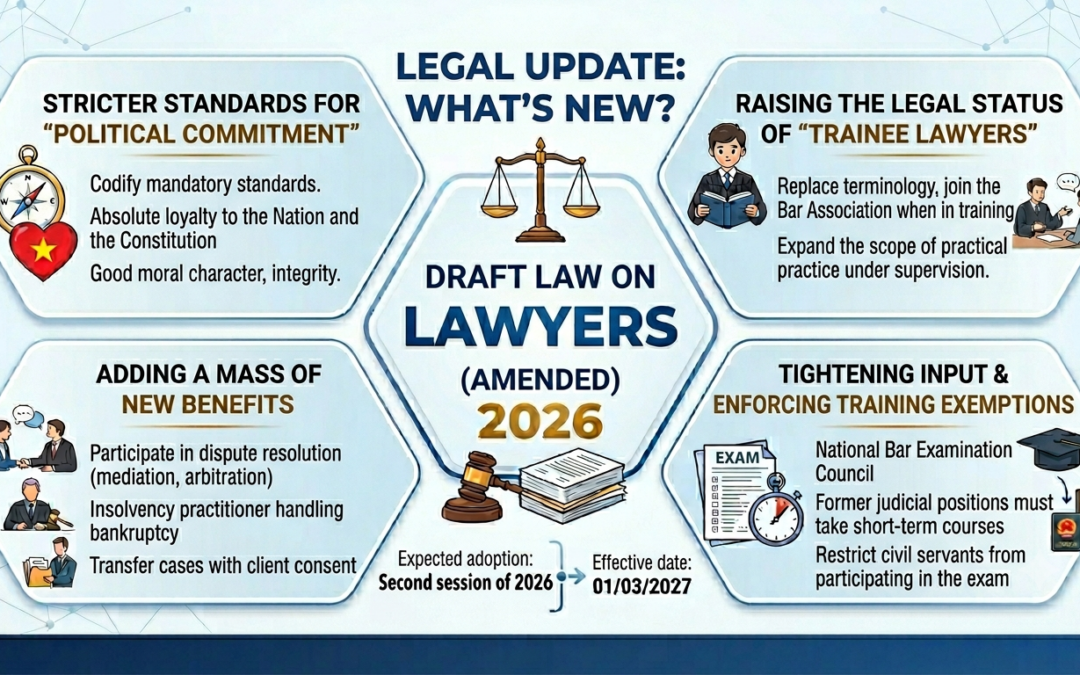
  • Promulgation and Effectiveness: The Draft Law on Lawyers (Amended) is expected to be passed by the 16th National Assembly of the Socialist Republic of Vietnam at its second session in 2026. This Law is anticipated to officially take effect on March 1, 2027, completely replacing the current Law on Lawyers No. 65/2006/QH11.
  • Scope of regulation: The draft comprehensively regulates the principles, standards, conditions, scope, and forms of practicing law. Besides, the law also governs the rights and obligations of lawyers, trainee lawyers, law-practicing organizations, socio-professional organizations of lawyers, the management of lawyers, and the operations of foreign law-practicing organizations and foreign lawyers in Vietnam.
  • Transitional provisions: To protect the legitimate rights and interests of personnel in the process of joining the profession, the draft stipulates that those currently undergoing traineeship under the old law will continue to have their traineeship period calculated under the new law. The results of the law practice traineeship examination under current regulations remain valid to request the issuance of a Lawyer Practicing Certificate until the end of January 1, 2030. Notably, cadres, civil servants, public employees, and military officers, after being granted the Practicing Certificate, have the right to join the Bar Association to become “public lawyers” (luật sư công) in accordance with the pilot Resolution of the National Assembly.

B. SEVERAL NEED-TO-KNOW ISSUES

  1. Supplementing stricter standards on “Political fortitude”
  • Main content: The breakthrough highlight of the draft is the codification of the standard “having firm political fortitude” into a prerequisite and mandatory condition to join the contingent of lawyers. This is an orientation to build a team of lawyers with pure ethics and a firm political stance.
  • Legal basis: Article 7 of the Draft Law.
  • Conditions, procedures, obligations: Besides professional foundations such as holding a bachelor’s degree in law or higher and completing vocational training, Vietnamese citizens wishing to become lawyers must demonstrate absolute loyalty to the Fatherland and the Constitution. Concurrently, practitioners must prove their good moral character, courageous spirit, and determination to protect justice, integrity, and honesty.
  1. Elevating legal status with the designation “Trainee lawyer”
  • Main content: The draft replaces the term “apprentice in law practice” with “trainee lawyer”, thereby approaching international practices and elevating the status of this group of subjects. Along with the new title, trainee lawyers are officially allowed to join the Bar Association right during the traineeship stage and have an expanded scope of practice.
  • Legal basis: Article 2, Article 9 of the Draft Law.
  • Conditions, procedures, obligations: The standard traineeship period is 12 months. Trainee lawyers are entitled to participate in legal proceedings in civil cases and administrative cases at the regional People’s Court, and simultaneously provide legal advice and draft documents. However, all these activities must be subject to the assignment and supervision of the guiding lawyer, with the client’s consent, and they must absolutely not sign legal advisory documents themselves.
  1. Supplementing a series of new rights for Lawyers
  • Main content: The draft grants more powerful “legal weapons”, allowing lawyers to participate more deeply and broadly in the economy and legal life. Lawyers are empowered to represent clients in dispute resolution as mediators, arbitrators, or directly participate in corporate recovery and bankruptcy handling under the title of bankruptcy administrators.
  • Legal basis: Article 12 of the Draft Law.
  • Conditions, procedures, obligations: The draft also adds a flexible mechanism allowing lawyers the right to transfer cases to other lawyers. To execute this right, the lawyer must ensure the prerequisite condition of having the client’s consent or proving the occurrence of a force majeure event.
  1. Tightening the National Examination and restricting the training exemption
  • Main content: The input quality management structure is tightened through the establishment of the National Examination Council for Lawyers. The draft also restricts the scope of training exemption, requiring those who formerly held judicial titles (judges, prosecutors, investigators) to undergo a short-term lawyer vocational training course in order to change their procedural mindset and strictly comply with the legal professional code of ethics.
  • Legal basis: Article 8, Article 10 of the Draft Law.
  • Conditions, procedures, obligations: Every trainee lawyer, after completing the 12-month traineeship, must mandatorily pass the national examination for lawyers to be considered for the Practicing Certificate. Incumbent cadres, civil servants, public employees, and armed forces personnel (except for law lecturers) shall not be permitted to attend this exam.

IN SUMMARY: The Draft Law on Lawyers (Amended) 2026 clearly reflects a new and integrative legislative mindset: on one hand, it grants more tools and an open legal space for lawyers to maximize their role; on the other hand, it establishes strict technical barriers regarding political, training, and examination standards to filter, elevate the position, and improve the quality of the legal services market in Vietnam.


NEED TO KNOW LEGAL ISSUES IN ELECTRONIC CONTRACTS

NEED TO KNOW LEGAL ISSUES IN ELECTRONIC CONTRACTS

NEED-TO-KNOW

LEGAL ISSUES IN ELECTRONIC CONTRACTS

A. OVERVIEW

  • Promulgation and Effective Date: The Law on Electronic Transactions No. 20/2023/QH15 was passed by the National Assembly on June 22, 2023, and officially takes effect from July 1, 2024. The promulgation of this law aims to replace the Law on Electronic Transactions 2005, thereby creating a complete and synchronous legal framework, strongly serving the national digital transformation.
  • Scope of Regulation: A breakthrough of the new Law is the comprehensive expansion of its scope of application. The Law currently regulates the implementation of transactions by electronic means in all activities of agencies, organizations, and individuals. Unlike before, the law no longer excludes important fields such as land, inheritance, and valuable papers, except in cases where specialized laws prohibit implementation by electronic means.
  • Transitional Provisions: To ensure stability, digital certificates and licenses issued before June 22, 2023, shall continue to be valid until their expiration date. In particular, the confirmation of registration for the provision of electronic contract authentication services in commerce shall continue to be used until the end of June 30, 2027.

B. SEVERAL NEED-TO-KNOW ISSUES

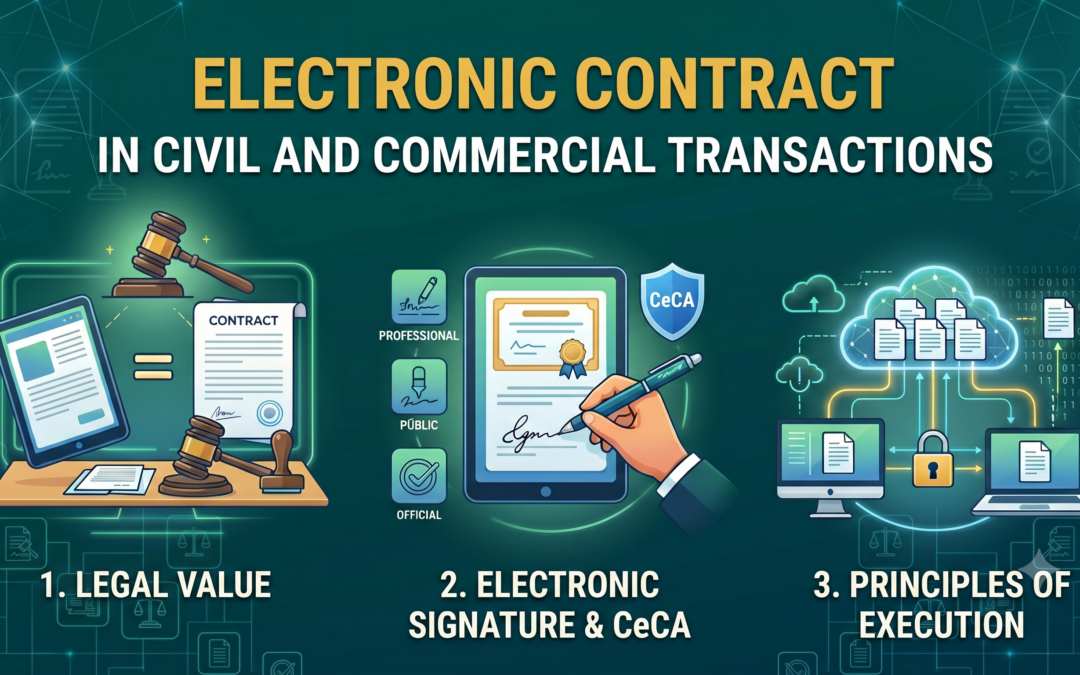
  1. Concept and Legal Validity of Electronic Contracts
  • Main content: An electronic contract is defined as a contract established in the form of a data message. As a core principle, an electronic contract has legal validity entirely equivalent to a traditional paper contract; its legal validity cannot be denied solely because it is expressed in electronic form or generated and entered into through automated information systems.
  • Legal basis: Article 34 of the Law on Electronic Transactions 2023; Article 401 of the Civil Code 2015.
  • Conditions, procedures, and obligations: Similar to traditional contracts, electronic contracts must satisfy the general conditions for the validity of civil transactions, such as: the subjects’ civil behavioral capacity, voluntariness, and purposes that do not violate legal prohibitions. Technically, the information in the contract must ensure integrity (unaltered, except for formal changes during storage and display) and be accessible and usable in its complete form for reference when necessary.
  1. Principles of Entering into and Executing Contracts
  • Main content: Entering into an electronic contract means using data messages to conduct part or all of the transaction. Participating parties are granted the freedom to agree on the use of electronic means, freely negotiate technical requirements, as well as conditions ensuring the integrity and confidentiality of the contract.
  • Legal basis: Articles 35 and 36 of the Law on Electronic Transactions 2023.
  • Conditions, procedures, and obligations: The process of entering into a contract must strictly comply with the Law on Electronic Transactions, contract laws, and relevant specialized laws. Notably, during the execution and performance processes, notifications in the form of data messages have the exact same legal validity as paper-based notifications.
  1. Role and Classification of Electronic Signatures
  • Main content: An electronic signature is a core legal tool to verify the identity of the signatory and confirm their approval of the contract’s content. The Law on Electronic Transactions 2023 clearly classifies electronic signatures into 3 groups: specialized electronic signatures, public digital signatures, and specialized digital signatures for official duties.
  • Legal basis: Articles 22, 23, and 25 of the Law on Electronic Transactions 2023.
  • Conditions, procedures, and obligations: A digital signature is recognized as a lawful electronic signature when the signature creation data is exclusively linked to the approved content of the data message, is under the sole control of the signatory at the time of signing, and any subsequent alteration to the data message can be detected. A secure specialized electronic signature or a digital signature shall have a legal validity equivalent to a handwritten signature.
  1. Trust Services and Electronic Contract Authentication (CeCA)
  • Main content: To enhance security and prevent disputes, the Law adds a mechanism on “Trust Services”, including: issuing time stamps, data message authentication, and public digital signature authentication. When utilizing electronic contract authentication services from CeCA (Certified e-Contract Authority) organizations, the contract will be “blue-ticked,” ensuring the highest level of integrity and non-repudiation.
  • Legal basis: Articles 28 and 29 of the Law on Electronic Transactions 2023.
  • Conditions, procedures, and obligations: Providing trust services is a conditional business line. Providing organizations must be licensed by the Ministry of Information and Communications, meeting strict standards on finance, personnel, and technical systems ensuring information security. For electronic contract authentication organizations in commerce, in addition to the above conditions, they must also meet the provisions of e-commerce laws.

IN SUMMARY:With the introduction of the Law on Electronic Transactions 2023, electronic contracts now have a solid legal framework, recognizing their value as equivalent to traditional contracts. For transactions to take place quickly, safely, and with high evidentiary value, subjects need to focus on meeting the formal conditions of data messages, utilizing compliant digital signatures, and considering the use of reliable electronic authentication services to optimally protect their legitimate rights and interests.


NEED TO KNOW LEGAL ISSUES IN THE CONSULAR LEGALIZATION OF FOREIGN DOCUMENTS USED IN VIETNAM

NEED TO KNOW LEGAL ISSUES IN THE CONSULAR LEGALIZATION OF FOREIGN DOCUMENTS USED IN VIETNAM

NEED-TO-KNOW

LEGAL ISSUES IN THE CONSULAR LEGALIZATION OF FOREIGN DOCUMENTS USED IN VIETNAM

A. OVERVIEW

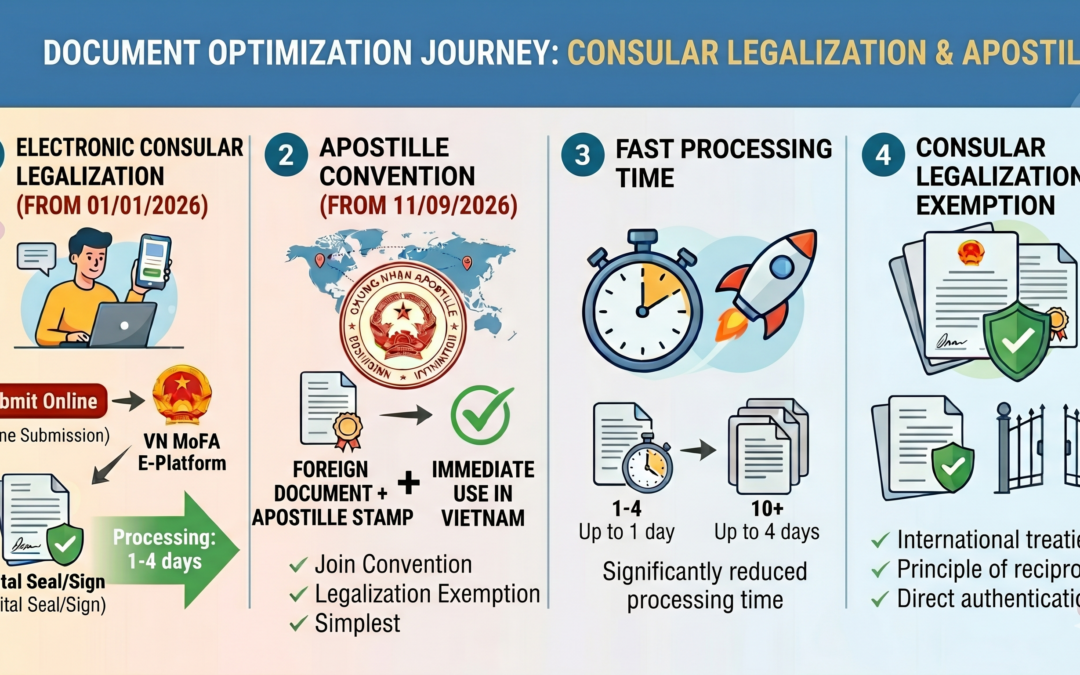
  • Promulgation and Effectiveness: The fundamental legal framework for consular legalization is stipulated in Decree No. 111/2011/ND-CP dated December 5, 2011; Decree No. 196/2025/ND-CP dated July 4, 2025, amending and supplementing Decree No. 111/2011/ND-CP, which takes effect on August 3, 2025.
  • Scope of Regulation: Regulates the competence, order, and procedures for the consular legalization of foreign papers and documents to be recognized and used in Vietnam.
  • Transitional Provisions: For dossiers submitted before August 3, 2025, the provisions of Decree 111/2011/ND-CP shall continue to apply. Notably, the regulations on electronic consular certification and legalization will be officially applied from January 1, 2026.

B. SEVERAL NEED-TO-KNOW ISUES  

  1. The nature and mandatory requirements of consular legalization
  • Main content: Consular legalization is the certification by competent Vietnamese agencies of the stamps, signatures, and titles on foreign papers and documents so that they can be recognized and legally used in Vietnam. It should be noted that this procedure only certifies the form (stamp, signature, title) and does not entail the certification of the content of the documents.
  • Legal basis: Articles 2, 3, and 4 of Decree 111/2011/ND-CP.
  • Conditions, procedures, and obligations: Except for exempted cases, all foreign papers and documents intended to be recognized and used legally in Vietnam must mandatorily undergo the consular legalization procedure.

2. Cases where foreign documents are exempted from consular legalization

  • Main content: According to the latest regulations, foreign documents are exempted from consular legalization if they fall into one of the following cases: (i) Under an international treaty to which both Vietnam and the relevant foreign country are members, or based on the principle of reciprocity; (ii) Transferred directly or via diplomatic channels between competent authorities; (iii) Under the provisions of Vietnamese law; (iv) The receiving agency in Vietnam does not require it, based on its ability to self-determine the authenticity of the documents. Notably, Vietnam has officially acceded to the 1961 Hague Convention (Apostille Convention) abolishing the requirement of legalization for foreign public documents, which will take effect on September 11, 2026. From this point onward, public documents only need a single certification (Apostille stamp) issued by the originating country to be valid in member countries.
  • Legal basis: Article 9 of Decree 111/2011/ND-CP (amended by Decree 196/2025/ND-CP).

3. Cases of refusal of consular legalization

  • Main content: Competent authorities will refuse legalization if the documents fall into these categories: erased or modified without proper legal correction; forged or issued ultra vires (beyond authority); or containing contents that infringe upon the interests of the State of Vietnam. For paper documents, the signatures and stamps must be original. For electronic documents (applicable from 2026), the documents will be refused if they lack the digital signature of the competent person/agency, or fail to ensure data integrity and authenticity according to regulations on electronic transactions.
  • Legal basis: Article 10 of Decree 111/2011/ND-CP (amended and supplemented by Decree 196/2025/ND-CP).

4. Procedures and methods of submitting consular legalization dossiers

  • Main content: Investors can submit dossiers directly, via postal service, or online through the National Public Service Portal using an electronic identity account. A basic dossier includes: An application declaration form, personal identification documents, the documents requesting legalization (already certified by the foreign diplomatic mission), and a Vietnamese or English translation.The processing time has been shortened: 01 working day (for 1 to 4 documents), no more than 02 working days (for 5 to 9 documents), and a maximum of 04 working days for 10 or more documents.
  • Legal basis: Articles 14, 15, and 15a of Decree 111/2011/ND-CP (amended and supplemented by Decree 196/2025/ND-CP).

IN SUMMARY:Consular legalization is an essential legal step for foreign documents to take effect in Vietnam. The promulgation of Decree 196/2025/ND-CP, along with Vietnam’s accession to the Apostille Convention (effective in 2026), marks a major turning point in administrative procedure reform, process digitization, and cost reduction. Investors need to firmly grasp the list of exempted documents, ensure the legality of the original documents, and utilize the online submission method to optimize the time required to carry out investment procedures.

    NEED-TO-KNOW LEGAL ISSUES IN THE LAW ON INVESTMENT 2025

    NEED-TO-KNOW LEGAL ISSUES IN THE LAW ON INVESTMENT 2025

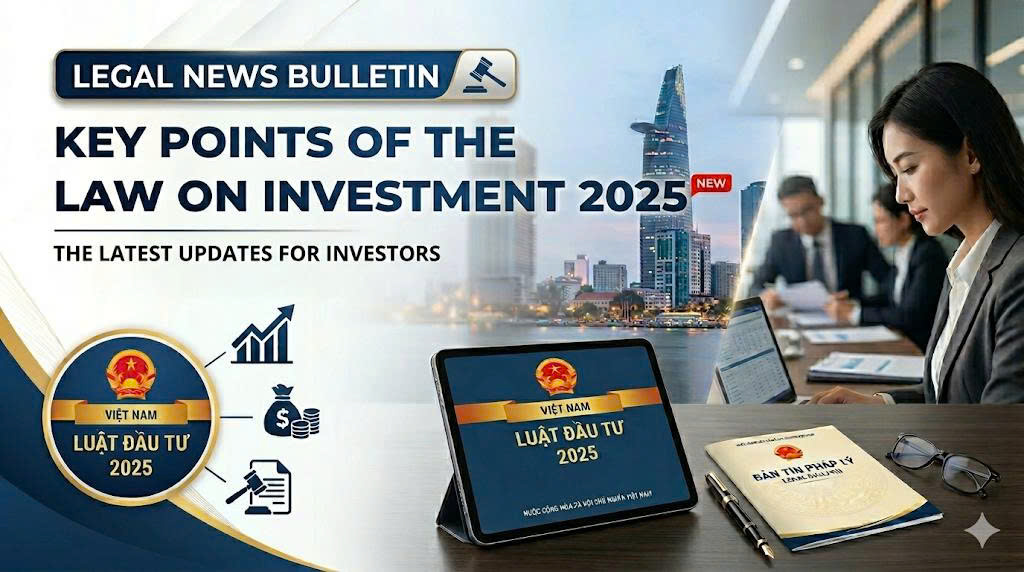
    LEGAL NEWS BULLETIN KEY POINTS OF THE LAW ON INVESTMENT 2025

    A. GENERAL INFORMATION

    • Date of promulgation: 11/12/2025.
    • Effective date: From 01/03/2026. Article 7 and Appendix IV shall take effect from 01/07/2026; Clause 3 Article 50 shall take effect from 01/01/2026.
    • Scope of regulation: Regulating investment and business activities in Vietnam and outward investment activities from Vietnam to foreign countries.
    • Transitional provisions: Investors that were granted Investment Licenses, Investment Incentive Certificates, Investment Certificates, Investment Registration Certificates, or written decisions or approvals of investment policy prior to the effective date of this Law shall continue to implement their projects in accordance with the issued documents.

    B. KEY ISSUES TO NOTE

    1. Addition of prohibited investment and business sectors

    • Key updates: Additional prohibited sectors include trading in national treasures; export of relics and antiques; e-cigarettes and heated tobacco products. This is a completely new provision compared to the Law on Investment 2020. For the first time, these business activities are officially added to the list of prohibited investment and business sectors.
    • Legal basis: Clause 1 Article 6 of the Law on Investment 2025[1].

    2. Reduction and transformation of management methods for conditional investment and business sectors

    • Key updates: Abolition of 38 sectors and amendment of the regulatory scope of 20 conditional investment and business sectors. A strong shift from “pre-licensing” (granting permits and certificates) to “post-licensing supervision” (publicizing requirements and business conditions).
    • Legal basis: Article 7 and Appendix IV of the Law on Investment 2025[2].

    3. Amendments and supplements to forms of investment support and investment incentives

    • Key updates: Addition of new forms of investment support such as green transition and digital transformation, and the introduction of an open framework for investment support, while clarifying the authority of state agencies. The method of identifying incentivized sectors is changed from a listing approach to a development-oriented approach, expanding to new sectors such as semiconductors and the digital economy. At the same time, special investment incentives are made more flexible by abolishing rigid criteria and assigning the Government to provide detailed regulations, and expanding the scope of application to strategic technology sectors.
    • Legal basis: Articles 14, 15 and 17 of the Law on Investment 2025[3].

    4. Establishment of economic organizations by foreign investors

    • Key updates: Foreign investors are permitted to establish economic organizations to implement investment projects before carrying out procedures for the issuance or adjustment of Investment Registration Certificates. Under the previous law, foreign investors were required to have a project before establishing an enterprise.
    • Legal basis: Clause 2 Article 19 of the Law on Investment 2025[4].

    5. Additional provisions on cases where foreign investors must carry out registration procedures for capital contribution, share purchase, or capital contribution purchase upon changes in members or shareholders

    • Key updates: Additional provisions on cases where foreign investors must conduct registration procedures prior to capital contribution, share purchase, or capital contribution purchase, including: cases of increasing ownership ratio in conditional sectors; cases of exceeding or increasing ownership above 50% of charter capital; and cases where economic organizations hold land use rights in sensitive areas related to national defense and security such as border areas, coastal areas, and islands.
    • Legal basis: Clause 3 Article 21 of the Law on Investment 2025[5].

    6. Clarification and narrowing of projects subject to investment policy approval

    • Key updates: Detailed provisions on 20 specific types of projects subject to investment policy approval, while clearly excluding certain projects that are not required to carry out this procedure (such as auctioned mineral exploitation projects and industrial cluster infrastructure projects). The authority for approval is also strongly decentralized to the Prime Minister and Chairpersons of provincial People’s Committees.
    • Legal basis: Articles 24 and 25 of the Law on Investment 2025[6].

    7. Removal of two cases requiring adjustment of investment projects

    • Key updates: The Law retains only five cases in which investors are required to carry out procedures for approval of adjustment of investment policy. Two cases have been abolished compared to the Law on Investment 2020, including: (i) changes in total investment capital of 20% or more resulting in changes in project scale; and (ii) changes to technologies that have been appraised.
    • Legal basis: Clause 3 Article 33 of the Law on Investment 2025[7].

    8. Allowing flexibility in adjusting the duration of investment projects

    • Key updates: During project implementation, investors are allowed to proactively increase or decrease the duration of investment projects, provided that the adjusted duration does not exceed the prescribed limits (50 years or 70 years depending on the area). Compared to the Law on Investment 2020, this is significantly more flexible, as previously extensions were only allowed when the project duration was about to expire.
    • Legal basis: Clause 4 Article 31 of the Law on Investment 2025[8].

    9. Expansion of the right to apply special investment procesures

    • Key updates: Investors in industrial zones, export processing zones, high-tech zones, concentrated digital technology zones, free trade zones, and international financial centers have the right to opt for special investment procedures. Projects under this mechanism are not required to obtain investment policy approval, environmental impact assessment reports, detailed planning, construction permits, or fire prevention and fighting approvals, and are instead implemented based on a commitment mechanism to satisfy conditions.
    • Legal basis: Article 28 of the Law on Investment 2025[9].

    10. Simplification of outward investment procedures

    • Key updates: Abolition of the requirement for approval of outward investment policy (previously under the authority of the National Assembly and the Prime Minister). Instead, only the procedure for issuance of an Outward Investment Registration Certificate by the Ministry of Finance is required for applicable projects; in cases of large-scale projects or those with special mechanisms, a report must be submitted to the Prime Minister for consideration before issuance. At the same time, detailed provisions on the implementation of outward investment activities (such as opening capital accounts, transferring capital, using and remitting profits) are converted into framework regulations, with detailed guidance assigned to the Government, in order to enhance flexibility.
    • Legal basis: Articles 41, 42 and 43 of the Law on Investment 2025[10].

    11. Changes in regulations applicable to the transfer of investment projects

    • Key updates: Regulations on the transfer of investment projects under investment law are expanded to apply to all projects that have been decided on investment policy, approved for investment policy (or adjusted), or granted or adjusted Investment Registration Certificates. Previously, the Law on Real Estate Business applied more narrowly.
    • Legal basis: Clause 7 Article 51 of the Law on Investment 2025[11].

    [1] Article 6. Banned business lines

    1. The business investment activities below are banned: i) Trade in national treasures; k) Trade in and export of relics and antiques; l) Trade in electronic cigarettes and heated tobacco products.”.

    [2] Article 7. Conditional business lines

    1. Conditional business line means a business line in the territory of Vietnam in which the business investment must satisfy necessary conditions for reasons of national defense and security, social order and security, social ethics, or the health of the community. The List of conditional business lines is specified in Appendix IV to this Law.

    The Government shall introduce a List of conditional business lines requiring licensing and certification before commencing investment and business activities, and a List of conditional business lines requiring a shift in the business condition management method from licensing and certification to declaration of fulfillment of business requirements and conditions for adoption of the post-inspection management method.”.

    [3] Article 14. Investment incentives and investment support

    3. Forms of investment support include… h) Support for green transition, emission reduction, climate change adaptation and digital transformation; i) Other forms of investment support as prescribed by the Government.”.

    Article 15. Business lines and geographical areas eligible for investment incentives

    1. Business lines eligible for investment incentives are business lines prioritized to attract investment to achieve the following objectives:

    a) Science and technology development, innovation, digital transformation, digital technology industry and semiconductor industry;… h) Development of key chemical industries, key mechanical engineering industries, supporting industries; development of pharmaceutical industry.”.

    Article 17. Special investment incentives and support

    2. Objects eligible for special investment incentives and support specified in clause 1 of this Article include:

    a) Projects on investment in establishment (including the expansion of such newly established project) of new innovation centers and research and development centers, investment projects on construction of big data center infrastructure, cloud computing infrastructure, 5G-and-above mobile infrastructure, and other digital infrastructure in the field of strategic technology as decided by the Prime Minister; investment projects in the field of strategic technology and production of strategic technology products as decided by the Prime Minister with investment capital and disbursement deadlines as prescribed by the Government; national innovation centers established by decisions of the Prime Minister.”.

    [4] Article 19. Investment in establishment of an economic organization

    2. A foreign investor is entitled to establish an economic organization to execute an investment project before following the procedures for issuance or adjustment of an investment registration certificate and must satisfy the market access conditions applied to foreign investors set out in Article 8 of this Law upon following the procedures for establishing an economic organization.”.

    [5] Article 21. Investment in form of capital contribution or purchase of shares or stakes

    3. A foreign investor shall follow procedures for registering their contribution of capital to or purchase of shares or stakes of an economic organization prior to the change of members or shareholders if they fall into one of the following cases:

    a) The capital contribution or purchase of shares or stakes leads to an increase in the foreign investors’ ownership in the economic organization conducting business in the restricted business lines;… c) The foreign investor contributes capital to or purchases shares or stakes of an economic organization that holds a certificate of rights to use land on an island or on a commune, ward or special zone in a border area; coastal commune or ward; in another area that affects national defense and security.”.

    [6] “Article 24. Projects subject to investment policy approval

    1. Investment projects that require repurposing of land of special-use forests, headwater protection forests or border protection forest of 50 hectares or more; of wind- and sand-shielding protection forests or protection forests for tide shielding and sea encroachment prevention of 500 hectares or more; of production forests of 1,000 hectares or more;…

    20. Investment projects that require application of a special mechanism or policy which is different from that prescribed by laws and resolutions of the National Assembly.

    Article 25. Authority to grant investment policy approval

    2. Except the case specified in clause 1 of this Article, the Prime Minister shall grant investment policy approval

    3. Except the investment projects specified in clause 1 and clause 2 of this Article, the Chairperson of the provincial People’s Committee shall grant investment policy approval.”.

    [7] “Article 33. Adjustment of investment projects

    3. An investor executing an investment project granted the investment policy approval shall follow procedures for investment policy adjustment approval in one of the following cases: b) The area of land used is increased or reduced is changed according to the Government’s regulations, the investment location is changed; c) The investment project execution schedule is extended by no more than 24 months as prescribed in clause 4 of this Article; d) The operating duration of the investment project is adjusted.”.

    [8] Article 31. Operating duration and execution schedule of investment projects

    4. During the execution of an investment project, the investor may increase or reduce the project’s operating duration. The operating duration of the investment project after the increase or reduction must not exceed the duration stipulated in clauses 1 and 2 of this Article.”.

    [9] Article 28. Special investment procedures

    1. An investor is entitled to register their investment in accordance with the provisions of this Article with regard to an investment project in an industrial park, export-processing zone, hi-tech zone, concentrated digital technology zone, free trade zone, international financial center or functional section in an economic zone, except a project requiring investment policy approval as prescribed by the Government. 2. An investment project registered under the provisions of this Article are not required to follow the procedures for investment policy approval, technology appraisal, preparation of an environmental impact assessment report or preparation of a detailed planning scheme, issuance of a construction permit, and other procedures for approval, acceptance, and permission in the fields of construction and fire prevention and fighting.”.

    [10] Article 42. Issuance, adjustment and invalidation of outward investment registration certificates

    1. The Ministry of Finance shall issue, adjust and invalidate outward investment registration certificates for projects with a level of outward investment capital prescribed by the Government or investment projects involved in the fields under business lines subject to conditional outward investment as specified in clause 1 Article 41 of this Law. Where necessary, the Ministry of Finance may delegate the authority to issue, adjust and invalidate outward investment registration certificates to organizations under the Ministry.

    Article 43. Conduct of outward investment activities

    The Government shall stipulate the opening of outward investment capital accounts, transfer of investment capital overseas, use of profit overseas, repatriation of profit and conduct of outward investment activities.”.

    [11] Article 51. Effect

    7. The provisions of clause 1 Article 41 of the Law on Real Estate Business No. 29/2023/QH15 apply to projects which have received investment policy decisions, investment policy adjustment decisions, investment policy approvals and investment policy adjustment approvals or have been granted investment registration certificates or adjusted investment registration certificates in accordance with the law on investment.”.
     

    NEED-TO-KNOW LEGAL ISSUES IN PERSONAL DATA PROTECTION

    NEED-TO-KNOW LEGAL ISSUES IN PERSONAL DATA PROTECTION

    NEED-TO-KNOW
    LEGAL ISSUES IN PERSONAL DATA PROTECTION

    1. OVERVIEW

    • Promulgation and Entry into Force: The Law on Personal Data Protection (Law No. 91/2025/QH15) was ratified by the National Assembly on June 26, 2025. To provide further details, the Government issued Decree No. 356/2025/ND-CP on December 31, 2025. Both legal documents officially come into force as of January 1, 2026. From this date, Decree No. 13/2023/ND-CP shall cease to have effect.
    • Scope and Regulated Entities: The Law applies to Vietnamese agencies, organizations, and individuals; foreign agencies, organizations, and individuals in Vietnam; and foreign entities directly participating in or involved in the processing of personal data of Vietnamese citizens and persons of Vietnamese origin without determined nationality residing in Vietnam who have been issued with identification certificates.
    • Transitional Provisions: Personal data processing activities conducted with the consent of data subjects or under agreements as prescribed in Decree No. 13/2023/ND-CP before the effective date of this Law shall continue to be carried out without the need to obtain new consent. Dossiers for impact assessment of personal data processing and cross-border transfer received by authorities before the effective date continue to be used, however, any updates made after the effective date must comply with the new Law. Notably, small-sized enterprises and startups may choose whether or not to implement regulations on preparing impact assessment dossiers and designating personal data protection personnel within 5 years from the effective date. This exemption does not apply if the entity provides personal data processing services, directly processes sensitive personal data, or reaches a processing scale of 100,000 or more personal data subject matters. Household businesses and micro-enterprises are also eligible for these exceptions under similar conditions.

     2. KEY ISSUES TO NOTE

    Firstly, Classification and Principles of Personal Data Processing

    • Main Content: Personal data is categorized into two groups: Basic personal data (including surname, middle name, and given name, date of birth, place of residence, phone number, images of the individual, etc.). Sensitive personal data (including opinions on religion, health status biometric data and genetic characteristics, financial, banking, and credit information, location data, etc.). The collection and processing of personal data must be conducted with the consent of the personal data subject matter, except for specific cases such as protecting the life and health of the data subject or others in urgent cases or responding to emergencies.
    • Legal Basis: Article 2, Article 9 and Article 19 of the Law on Personal Data Protection 2025; Article 3, Article 4, and Article 5 of Decree No. 356/2025/ND-CP.
    • Conditions, Procedures and Obligations: In the course of processing sensitive personal data, agencies and organizations must establish regulations on access authorization and restriction, processing procedures, and confidentiality measures. Personal data controlling parties and personal data processing and controlling parties must develop clear procedures and forms for the exercise of the rights of the personal data subject matter (such as the right to withdraw consent or request data deletion). Response and implementation timelines are strictly regulated: authorities/organizations must respond within 02 working days and complete the implementation within 10 to 30 days depending on the type of request (e.g., 10 days for modification, 15 days for cessation of processing, and 20 days for deletion).
    • Relevant Entities: All individuals, enterprises, and organizations participating in or involved in the collection and storage of customer or employee information.

    Secondly, Preparation of Impact Assessment Dossiers for Personal Data Processing and Cross-border Transfer

    • Main Content: The personal data controlling party, personal data processing and controlling party, and personal data processing party are mandatory to prepare impact assessment dossiers when performing personal data processing or cross-border personal data transfer. This includes activities such as transferring personal data collected and stored in Vietnam to server systems or cloud computing services located outside the territory of Vietnam.
    • Legal Basis: Articles 20, 21 and 22 of the Law on Personal Data Protection 2025; Articles 17 to 20 of Decree No. 356/2025/ND-CP.
    • Conditions, Procedures and Obligations: Relevant entities must prepare and send 01 original complete dossier to the personal data protection authority (Ministry of Public Security) within 60 days from the date of commencement of personal data processing or cross-border transfer. Dossiers must be updated biannually (every 6 months) if there are changes to the purposes of transfer/processing or changes in the parties involved. Immediate updates must be performed within 10 days in cases of reorganization, operational termination, or when new business services concerning personal data processing arise.
    • Relevant Entities: Personal data controlling and processing parties, especially foreign entities, and organizations utilizing international software solutions or cross-border cloud platforms.

    Thirdly, Assignment of Forces, Units, and Personnel for Personal Data Protection

    • Main Content: Agencies and organizations are responsible for designating personal data protection units or personnel with adequate capacity or hiring independent personal data protection service providers.
    • Legal Basis: Article 33 of the Law on Personal Data Protection 2025; Articles 13 to 16 of Decree No. 356/2025/ND-CP
    • Conditions, Procedures and Obligations: Designated personnel must hold at least a college-level degree or higher and have at least 02 years of working experience (or 03 years in the case of individuals providing hired services) related to fields such as legal affairs, information technology, risk management, or compliance control. These individuals must have received training and advanced training in legal knowledge and professional skills relating to personal data protection. The designation of personnel or units must be formalized through an official written document of the relevant agency or organization.
    • Relevant Entities: All agencies, organizations, and enterprises are generally required to comply. However, small-sized enterprises, startups, household businesses, and micro-enterprises are eligible for an exception and may choose whether or not to implement these personnel regulations within 05 years from the effective date of the Law. This exemption does not apply if the entity provides personal data processing services, directly processes sensitive personal data, or reaches a processing scale of 100,000 or more personal data subject matters.

    Fourthly, Notification of Incidents and Violations of Personal Data Protection

    • Main Content: Whenever violations against personal data protection regulations are detected that may harm national defense, security, social order, and safety or infringe on the life, health, honor, dignity, and property of personal data subject matters, organizations and individuals must issue notices to the competent authorities.
    • Legal Basis: Article 23 of the Law on Personal Data Protection 2025; Articles 8, 28, and 29 of Decree No. 356/2025/ND-CP.
    • Conditions, Procedures and Obligations: The notification to the personal data protection authority (Ministry of Public Security) must be issued within 72 hours from the detection of such violations. The personal data controlling party or personal data processing and controlling party must prepare a written confirmation of violations, implement measures to remedy consequences, and cooperate with the personal data protection authority in handling the violation.
      Special Note: For organizations operating in finance, banking, and credit information activities, or when a violation incident involves personal location data or biometric data, the organization is mandatory to notify both the personal data protection authority and the affected personal data subject matter within no more than 72 hours from the time the violation is detected.
    • Relevant Entities: Entities engaged in large-scale personal data collection, providers of platform application services providing personal location data, banks, credit institutions, securities institutions, and insurers.

    Fifthly, Business of Providing Personal Data Processing Services

    • Main Content: Activities such as services for analysis and utilization of personal data; services for scoring, rating, and assessing the creditworthiness of personal data subject matters; and providing/operating automated systems and software to process personal data on behalf of the personal data controlling party (e.g., SaaS, cloud computing) have officially become business lines for personal data processing services.
    • Legal Basis: Articles 21 to 27 of Decree No. 356/2025/ND-CP
    • Conditions, Procedures and Obligations: Organizations wishing to conduct business in this field are mandatory to obtain a Certificate of eligibility for providing personal data processing services issued by the Ministry of Public Security. Business conditions include: the head responsible for professional matters related to personal data processing must be a Vietnamese citizen permanently residing in Vietnam; having at least 03 personnel satisfying the statutory competency conditions for personal data protection; meeting standards for infrastructure, equipment systems, facilities, and technology suitable for the processing services. The application dossier includes: An application (Form No. 04), a business proposal, and relevant personnel dossiers (diplomas and documents proving qualifications).
    • Relevant Entities: Digital technology enterprises, tech companies (AI, Big Data, Blockchain, Cloud), data analysis centers, and organizations providing enterprise software services or behavioral advertising.

    In summary, to ensure compliance, relevant organizations and individuals may need to perform the following:

    • Review and classify personal data: Clearly distinguish between basic personal data and sensitive personal data within current storage systems.
    • Standardize procedures and forms: Update internal regulations and contracts; establish lawful methods to obtain consent from personal data subject matters and develop mechanisms to facilitate the exercise of their rights.
    • Designate specialized personnel or units: Issue decisions to appoint personal data protection personnel or a personal data protection unit satisfying the statutory competency conditions or enter into contracts with independent personal data protection service providers.
    • Complete Impact Assessment Dossiers (DPIA/TIA): Prepare and submit dossiers for personal data processing impact assessment and/or cross-border personal data transfer impact assessment to the personal data protection authority (Ministry of Public Security) no later than 60 days from the date of commencement of processing or transfer.
    • Establish incident response procedures: Ensure the internal capability to record and notify the competent authorities within 72 hours from the detection of personal data leaks or violations.
    • Apply for a Certificate of Eligibility: For entities engaged in the business of providing personal data processing services, prepare qualified personnel and infrastructure, and develop a business proposal to apply for a Certificate of eligibility for providing personal data processing services issued by the Ministry of Public Security.


    NEED-TO-KNOW LEGAL ISSUES IN ARTIFICIAL INTELLIGENCE

    NEED-TO-KNOW LEGAL ISSUES IN ARTIFICIAL INTELLIGENCE

    NEED-TO-KNOW
    LEGAL ISSUED IN ARTIFICIAL INTELLIGENCE

    1. OVERVIEW

    • Date of promulgation: The Law on Artificial Intelligence (Law No. 134/2025/QH15) was ratified by the National Assembly on December 10, 2025, and officially comes into force from March 01, 2026.
    • Scope of regulation: The Law regulates the research, development, provision, deployment, and use of artificial intelligence (hereinafter referred to as “AI”) systems; the rights and obligations of relevant organizations and individuals; and the state management of AI activities in Vietnam. The Law applies to Vietnamese authorities, organizations, and individuals, as well as foreign entities participating in AI activities in Vietnam. It does not apply to AI activities serving only national defense, security, and cipher activities.
    • Transitional provisions: For AI systems put into operation before March 01, 2026, providers and deployers are responsible for fulfilling compliance obligations within the following time limits from the effective date of the Law: 18 months for AI systems in the fields of health, education, and finance; 12 months for other AI systems. During these periods, the systems may continue to operate unless state management authorities determine a risk of causing serious damage and request the suspension or termination of operations.

    2. KEY ISSUES TO NOTE

    Firstly, Risk-based Classification and Management

    • Main Content and Legal Basis: According to Article 9, AI systems are classified into three risk levels: high, medium, and low. High-risk AI systems are those that cause or pose a risk of significant harm to life, health, legitimate rights and interests of organizations and individuals, national interests, public interests, or national security.
    • Conditions, Procedures and Obligations: Pursuant to Article 10 and Article 14, providers must self-classify AI systems before putting them into operation. For medium-risk and high-risk systems, providers must prepare classification dossiers and notify the classification results to the Ministry of Science and Technology via the single-window website on AI before operation. Specifically, high-risk AI systems must undergo conformity evaluation before operation; establish and maintain risk management measures; archive technical dossiers and activity logs; and ensure human oversight and intervention capabilities. Foreign providers with high-risk AI systems provided in Vietnam must have a legal contact point; in cases where the system is subject to mandatory conformity certification, they must have a commercial presence or an authorized representative in Vietnam.
    • Relevant Entities: Enterprises and organizations acting as providers (those who provide systems to the market) and deployers (those using systems to provide services) need to prioritize these regulations to perform classification and maintain continuous system conformity.

    Secondly, Transparency Obligations and Prohibited Activities

    • Main Content and Legal Basis: Detailed provisions are set out in Article 11 regarding transparency responsibility and Article 7 regarding prohibited activities in AI activities.
    • Conditions, Procedures and Obligations: Providers must ensure that AI systems interacting directly with humans are designed and operated so that users can recognize when they are interacting with the systems. Audio, images, and videos generated or edited by AI systems to simulate or imitate the appearance or voice of real persons (such as deepfakes) or reenact actual events must be marked in a machine-readable format and labeled clearly to distinguish them from human-made content and avoid confusion. Simultaneously, the Law strictly prohibits developing, providing, deploying, or using AI systems to deceive or manipulate human perception and behaviors; exploiting the vulnerabilities of vulnerable groups (including children, the elderly, persons with disabilities, etc.). It is also prohibited to collect, handle, or use data to train AI systems against the laws on protection of personal data or to conceal information that must be disclosed, transparent, or explained.
    • Relevant Entities: Developers, digital content solution providers, and application platforms directly interacting with users need to establish notification labeling features and automated content moderation systems.

    Thirdly, AI Regulatory Sandbox

    • Main Content and Legal Basis: Article 21 regulates the AI regulatory sandbox to encourage innovation.
    • Conditions, Procedures and Obligations: The sandbox is conducted under the supervision of competent state authorities, which are responsible for receiving and appraising dossiers in accordance with fast appraisal and response procedures. Authorities have the power to decide on the suspension or termination of the sandbox if risks to security, rights, or legitimate interests of organizations and individuals are detected. The results from the sandbox serve as a critical basis for the State to consider the recognition of conformity evaluation results, or the exemption, reduction, or adjustment of obligations prescribed in the Law.
    • Relevant Entities: Digital technology enterprises and startups developing new AI products and services that require a controlled, real-world environment for research, production, and commercialization.

    Fourthly, Incident Management

    • Main Content and Legal Basis: Article 12 stipulates the responsibilities for reporting and handling serious incidents, which are events occurring during the operation of an AI system that cause or pose a risk of significant harm to life, health, human rights, property, cybersecurity, etc.
    • Conditions, Procedures and Obligations: When a serious incident occurs, developers and providers must promptly apply technical measures to fix, suspend, or recall the system, and notify competent authorities. Deployers and users are obligated to promptly record and notify incidents and cooperate in the fixing process. The entire process of reporting and handling incidents must be conducted via the single-window website on AI.
    • Relevant Entities: Developers, providers, deployers, and users all bear responsibilities for ensuring security and reliability, with specific obligations assigned to each entity based on the level of incident response.

    In summary, to ensure compliance, relevant organizations and individuals may need to perform the following:

    • Review, evaluate, and self-classify the risk levels (high, medium, and low) for AI systems currently under development or being provided to the market.
    • Prepare notification procedures for medium-risk and high-risk AI systems; conduct conformity evaluation for high-risk AI systems.
    • Implement labeling mechanisms and mark content in a machine-readable format for AI-generated outputs to fulfill transparency responsibilities.
    • Establish adjustment plans for existing AI systems within the transitional period (12 to 18 months starting from March 01, 2026).
    • Develop internal procedures for archiving technical dossiers and activity logs, data management, and establishing incident response scenarios and online reporting via the single-window website on AI when serious incidents occur.