NEED-TO-KNOW
LEGAL ISSUES IN ELECTRONIC CONTRACTS
A. OVERVIEW
- Promulgation and Effective Date: The Law on Electronic Transactions No. 20/2023/QH15 was passed by the National Assembly on June 22, 2023, and officially takes effect from July 1, 2024. The promulgation of this law aims to replace the Law on Electronic Transactions 2005, thereby creating a complete and synchronous legal framework, strongly serving the national digital transformation.
- Scope of Regulation: A breakthrough of the new Law is the comprehensive expansion of its scope of application. The Law currently regulates the implementation of transactions by electronic means in all activities of agencies, organizations, and individuals. Unlike before, the law no longer excludes important fields such as land, inheritance, and valuable papers, except in cases where specialized laws prohibit implementation by electronic means.
- Transitional Provisions: To ensure stability, digital certificates and licenses issued before June 22, 2023, shall continue to be valid until their expiration date. In particular, the confirmation of registration for the provision of electronic contract authentication services in commerce shall continue to be used until the end of June 30, 2027.
B. SEVERAL NEED-TO-KNOW ISSUES
- Concept and Legal Validity of Electronic Contracts
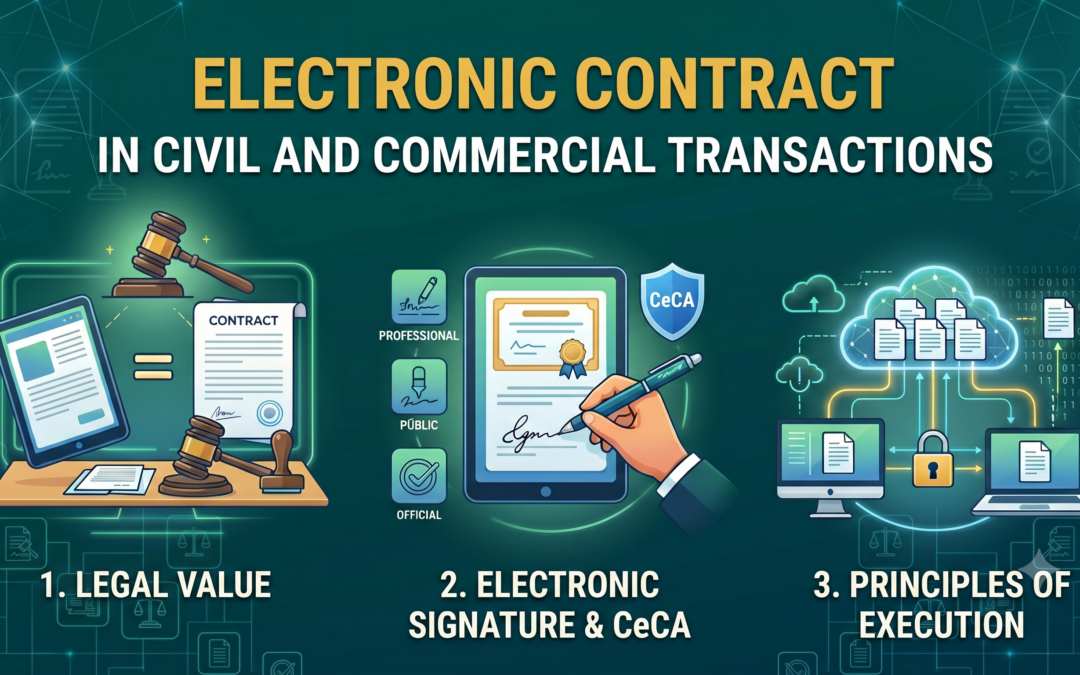
- Main content: An electronic contract is defined as a contract established in the form of a data message. As a core principle, an electronic contract has legal validity entirely equivalent to a traditional paper contract; its legal validity cannot be denied solely because it is expressed in electronic form or generated and entered into through automated information systems.
- Legal basis: Article 34 of the Law on Electronic Transactions 2023; Article 401 of the Civil Code 2015.
- Conditions, procedures, and obligations: Similar to traditional contracts, electronic contracts must satisfy the general conditions for the validity of civil transactions, such as: the subjects’ civil behavioral capacity, voluntariness, and purposes that do not violate legal prohibitions. Technically, the information in the contract must ensure integrity (unaltered, except for formal changes during storage and display) and be accessible and usable in its complete form for reference when necessary.
- Principles of Entering into and Executing Contracts
- Main content: Entering into an electronic contract means using data messages to conduct part or all of the transaction. Participating parties are granted the freedom to agree on the use of electronic means, freely negotiate technical requirements, as well as conditions ensuring the integrity and confidentiality of the contract.
- Legal basis: Articles 35 and 36 of the Law on Electronic Transactions 2023.
- Conditions, procedures, and obligations: The process of entering into a contract must strictly comply with the Law on Electronic Transactions, contract laws, and relevant specialized laws. Notably, during the execution and performance processes, notifications in the form of data messages have the exact same legal validity as paper-based notifications.
- Role and Classification of Electronic Signatures
- Main content: An electronic signature is a core legal tool to verify the identity of the signatory and confirm their approval of the contract’s content. The Law on Electronic Transactions 2023 clearly classifies electronic signatures into 3 groups: specialized electronic signatures, public digital signatures, and specialized digital signatures for official duties.
- Legal basis: Articles 22, 23, and 25 of the Law on Electronic Transactions 2023.
- Conditions, procedures, and obligations: A digital signature is recognized as a lawful electronic signature when the signature creation data is exclusively linked to the approved content of the data message, is under the sole control of the signatory at the time of signing, and any subsequent alteration to the data message can be detected. A secure specialized electronic signature or a digital signature shall have a legal validity equivalent to a handwritten signature.
- Trust Services and Electronic Contract Authentication (CeCA)
- Main content: To enhance security and prevent disputes, the Law adds a mechanism on “Trust Services”, including: issuing time stamps, data message authentication, and public digital signature authentication. When utilizing electronic contract authentication services from CeCA (Certified e-Contract Authority) organizations, the contract will be “blue-ticked,” ensuring the highest level of integrity and non-repudiation.
- Legal basis: Articles 28 and 29 of the Law on Electronic Transactions 2023.
- Conditions, procedures, and obligations: Providing trust services is a conditional business line. Providing organizations must be licensed by the Ministry of Information and Communications, meeting strict standards on finance, personnel, and technical systems ensuring information security. For electronic contract authentication organizations in commerce, in addition to the above conditions, they must also meet the provisions of e-commerce laws.
IN SUMMARY:With the introduction of the Law on Electronic Transactions 2023, electronic contracts now have a solid legal framework, recognizing their value as equivalent to traditional contracts. For transactions to take place quickly, safely, and with high evidentiary value, subjects need to focus on meeting the formal conditions of data messages, utilizing compliant digital signatures, and considering the use of reliable electronic authentication services to optimally protect their legitimate rights and interests.